
American Kestrel
American Kestrel – Spec. Name: Falco Sparverius
This is a small falcon, and the only kestrel found in the Americas. It is the most common falcon in North America, and is found in a wide variety of habitats. At 19–21 centimeters (7–8 in) long, it is also the smallest falcon in North America. It exhibits sexual dimorphism in size and plumage, although both genders have a rufous back with noticeable barring. Juveniles are similar in plumage to adults.

American Kestrel
The American Kestrel hunts by hovering in the air with rapid wing beats or perching and scanning the ground for prey. Its diet typically consists of grasshoppers, lizards, mice, and other small birds. It nests in cavities in trees, cliffs, buildings, and other structures. The female lays three to seven eggs, which both sexes help to incubate. It is a common bird to be used in falconry, especially by beginners.
Its breeding range extends from central and western Alaska across northern Canada to Nova Scotia, and south throughout North America, into central Mexico and the Caribbean. It is a local breeder in Central America and is widely distributed throughout South America. Most birds breeding in Canada and the northern United States migrate south in the winter. It is an occasional vagrant to western Europe.
At about the size of a large thrush, the American Kestrel is the smallest falcon in North America.The American Kestrel is sexually dimorphic, although there is some overlap in plumage coloration between the sexes. The bird is 19–21 centimeters (7–8 in) in length with a wingspan of 50–60 centimeters (20–24 in), with the female typically larger than the male. The male weighs 103–120 grams (3.6–4.2 oz), and the female 126–166 grams (4.4–5.9 oz).
Plumage has more variation between the sexes than size. Males have blue-grey wings with black spots and white undersides with black barring. The back is rufous, with barring on the lower half. The belly and flanks are white with black spotting. The tail is also rufous, with a white or rufous tip and a black subterminal band. The back and wings of the female American Kestrel are rufous with dark brown barring. The undersides of the females are creamy to buff with heavy brown streaking. The tail is noticeably different from the male’s, being rufous in color with numerous narrow dark black bars. Juveniles exhibit coloration patterns similar to the adults’. In both sexes, the head is white with a bluish-grey top. There are also two narrow, vertical black facial markings on each side of the head, while other falcons have one. Two black spots (ocelli) can be found on each side of the white or orangish nape. The function of these spots is debated, but the most commonly accepted theory is that they act as “false eyes”, and help to protect the bird from potential attackers. The wings are moderately long, fairly narrow, and taper to a point. While the kestrel is perched, the wingtips are noticeably shorter than the tail tip.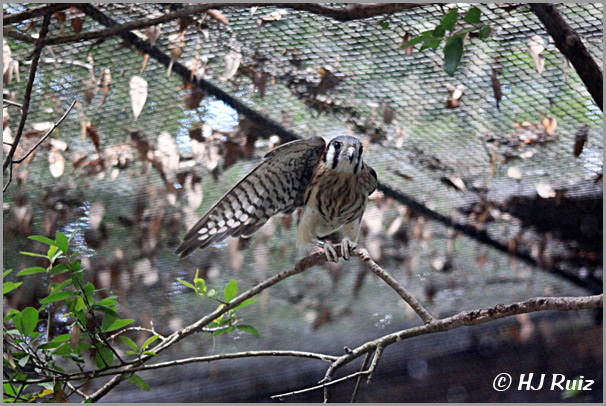
Photographs are © H.J. Ruiz – “My Backyard Visitors”
Text is available under the Creative Commons Attribution-ShareAlike License; additional terms may apply. See Terms of use for details.




 H.J. Ruiz - Avian101
You must be logged in to post a comment.