Double-crested Cormorant
Double-crested Cormorant – Spec. Name: Phalacrocorax Auritus
This is a member of the cormorant family of seabirds. It occurs along inland waterways as well as in coastal areas, and is widely distributed across North America, from the Aleutian Islands in Alaska down to Florida and Mexico.
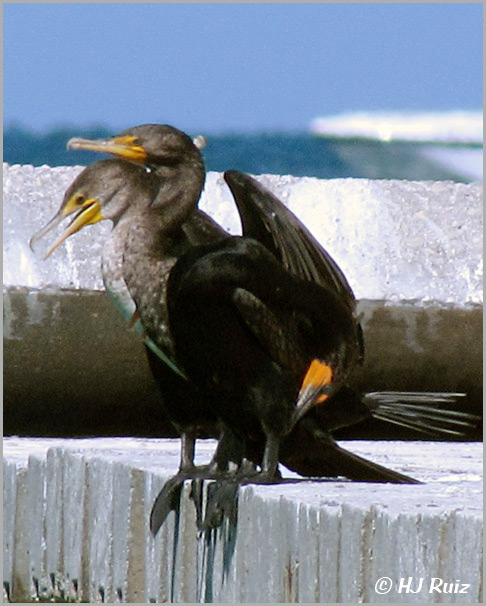
Double-crested Cormorants
The Double-crested Cormorant is a large waterbird with a stocky body, long neck, medium-sized tail, webbed feet and a medium sized hooked bill. It has a body length of between 70–90 cm (28–35 in) long, with a wingspan of between 114–132 cm (45–52 in). Double-crested Cormorants weigh between 1.2–2.5 kg (2.6–5.5 pounds) Males and females do not display sexual dimorphism.
This species has dark-colored plumage with bare super-loral skin and gular skin that is yellow or orange. An adult in breeding plumage will be mostly black with the back and coverts being a dark grayish towards the center. Nuptial crests, for which the species is named, are either white, black or a mix of the two. These are located just above the eyes with the bare skin on the face of a breeding adult being orange. A non-breeding adult will lack the crests and have more yellowish skin around the face. The bill of the adult is dark-colored.
The plumage of juvenile Double-crested Cormorants is more dark grey or brownish. The underparts of a juvenile are lighter than the back with a pale throat and breast that darkens towards the belly. As a bird ages, its plumage will grow darker. The bill of a juvenile will be mostly orange or yellowish.
Food can be found in the sea, freshwater lakes, and rivers. Like all cormorants, the double-crested dives to find its prey. It mainly eats fish, but will sometimes also eat amphibians and crustaceans. Fish are caught by diving under water. Smaller fish may be eaten while the bird is still beneath the surface but bigger prey is often brought to the surface before it is eaten. Cormorants regurgitate pellets containing undigested parts of their meals such as bones.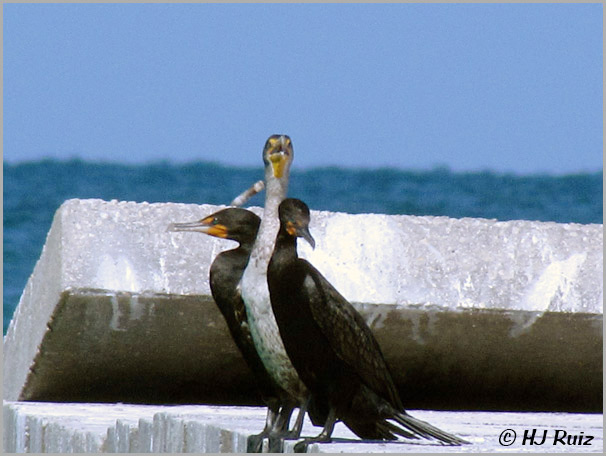
Photographs are © H.J. Ruiz – “My Backyard Visitors”
Text is available under the Creative Commons Attribution-ShareAlike License; additional terms may apply. See Terms of use for details.


 H.J. Ruiz - Avian101
You must be logged in to post a comment.