
Wild Turkey
Wild Turkey – Spec. Name: Meleagris Gallopavo
This bird is native to North America and is the heaviest member of the Galliformes. It is the same species as the domestic turkey, which was domesticated from the South Mexican subspecies of the wild turkey.
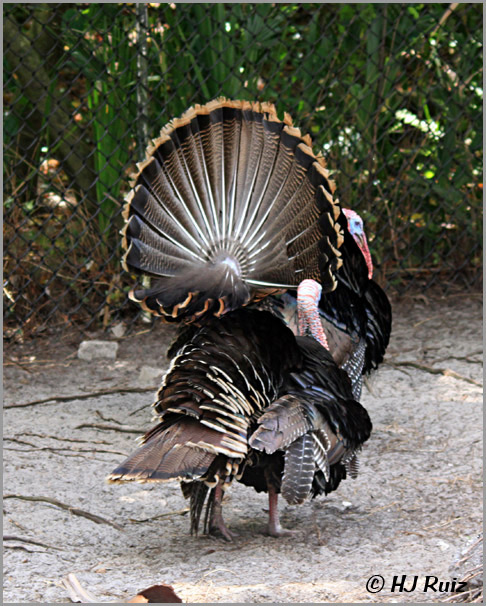
Wild Turkey
Adult wild turkeys have long reddish-yellow to grayish-green legs and a black body. Males, called toms or gobblers, have a large, featherless, reddish head, red throat, and red wattles on the throat and neck. The head has fleshy growths called caruncles. When males are excited, a fleshy flap on the bill expands, and this, the wattles and the bare skin of the head and neck all become engorged with blood, almost concealing the eyes and bill. The long fleshy object over a male’s beak is called as nood. When a male turkey’s excited, its head turns blue; when ready to fight, it turns red. Each foot has three toes, and males have a spur behind each of their lower legs.
Turkeys have a long, dark, fan-shaped tail and glossy bronze wings. As with many other species of the Galliformes, turkeys exhibit strong sexual dimorphism. The male is substantially larger than the female, and his feathers have areas of red, purple, green, copper, bronze, and gold iridescence. Females, called hens, have feathers that are duller overall, in shades of brown and gray. Parasites can dull coloration of both sexes; in males, coloration may serve as a signal of health. The primary wing feathers have white bars. Turkeys have 5000 to 6000 feathers. Tail feathers are of the same length in adults, different lengths in juveniles. Males typically have a “beard”, a tuft of coarse hair (modified feathers) growing from the center of the breast. Beards average 9 inches (230 mm) in length. In some populations, 10 to 20 percent of females have a beard, usually shorter and thinner than that of the male. The adult male normally weighs from 5 to 11 kg (11–24 pounds) and measures 100–125 cm (39–49 in). The adult female is typically much smaller at 3 to 5.4 kg (6.6–12 lbs) and is 76 to 95 cm (30–37 in) long. The wingspan ranges from 1.25 to 1.44 m (49–57 in). The record-sized adult male Wild Turkey, according to the National Wild Turkey Federation, weighed 38 lb (17.2 kg).
Despite their weight, wild turkeys are surprisingly agile fliers and cunning, unlike their domestic counterparts.
Turkeys are very cautious birds and will fly or run at the first sign of danger. Their ideal habitat is an open woodland or savanna, where they may fly beneath the canopy top and find perches. They usually fly close to the ground for no more than a quarter mile (400 m).
Wild turkeys are omnivorous, foraging on the ground or climbing shrubs and small trees to feed. They prefer eating hard mast such as acorns, nuts, and various trees, including hazel, chestnut, hickory, and pinyon pine as well as various seeds, berries such as juniper and bearberry, roots and insects. Turkeys also occasionally consume amphibians and small reptiles such as lizards and snakes.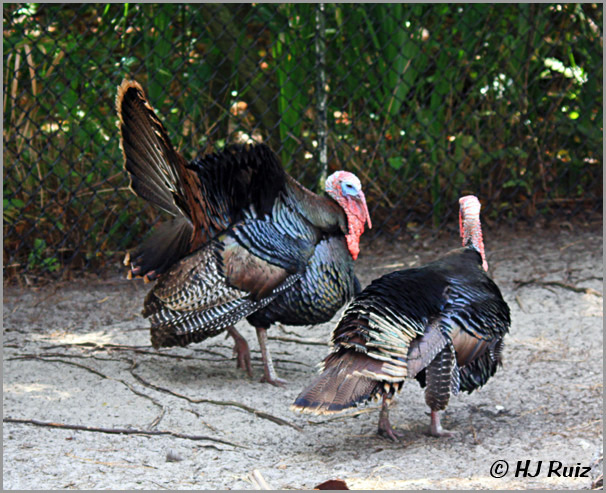
All photographs are © H.J. Ruiz – “My Backyard Visitors”
Text is available under the Creative Commons Attribution-ShareAlike License; additional terms may apply. See Terms of use for details.


 H.J. Ruiz - Avian101
You must be logged in to post a comment.