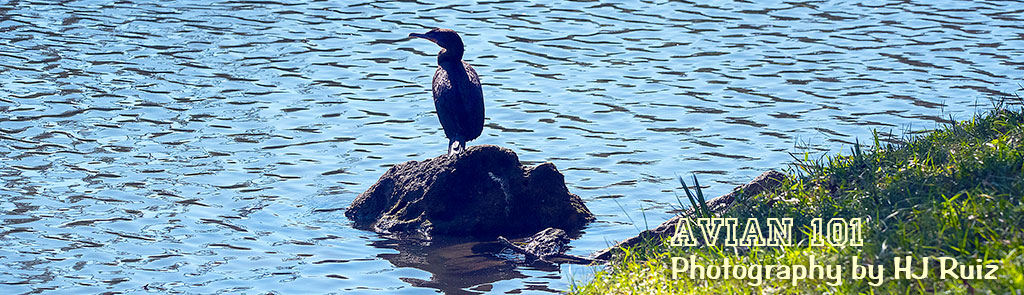
Common Moorhen
Common Moorhen, or Common Gallinule – Spec. Name: Gallinula Chloropus
This is a bird in the Rallidae family with an almost worldwide distribution. It lives around well-vegetated marshes, ponds, canals and other wetlands. These species are not found in the polar regions, or many tropical rainforests. But elsewhere the Common Moorhen is likely the most commonly seen rail species to most people, excepting the Eurasian Coot or American Coot in some regions.
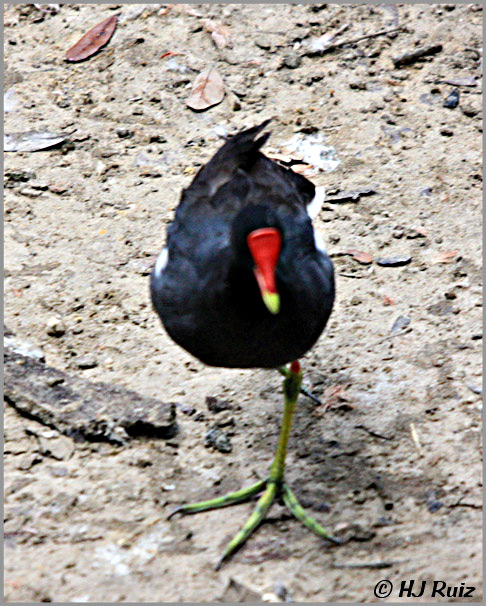
Common Moorhen
The Moorhen is a distinctive species, with dark plumage apart from the white undertail, yellow legs and a red facial shield. The young are browner and lack the red shield. It has a wide range of gargling calls and will emit loud hisses when threatened.
This is a common breeding bird in marsh environments and well-vegetated lakes. Populations in areas where the waters freeze, such as southern Canada, the northern USA and eastern Europe, will migrate to more temperate climes. This species will consume a wide variety of vegetable material and small aquatic creatures. They forage beside or in the water, sometimes upending in the water to feed. It is often secretive, but can become tame in some areas. Despite loss of habitat in parts of its range, the Common Moorhen remains plentiful and widespread.
The nest is a basket built on the ground in dense vegetation. Laying starts in spring, between mid-March and mid-May in N hemisphere temperate regions. About 8 eggs are usually laid per female early in the season; if later in the year they usually lay 5 eggs or less. Nests may be re-used by different females. Incubation lasts about three weeks. Both parents incubate and feed the young. These fledge after 40–50 days, become independent usually a few weeks thereafter, and may raise their first brood the next spring. When threatened, the young may cling to the parent’s body, after which the adult birds fly away to safety, carrying their offspring with them.
On a global scale – all subspecies taken together –, the Common Moorhen is as abundant as its vernacular name implies. It is therefore considered a species of Least Concern by the IUCN.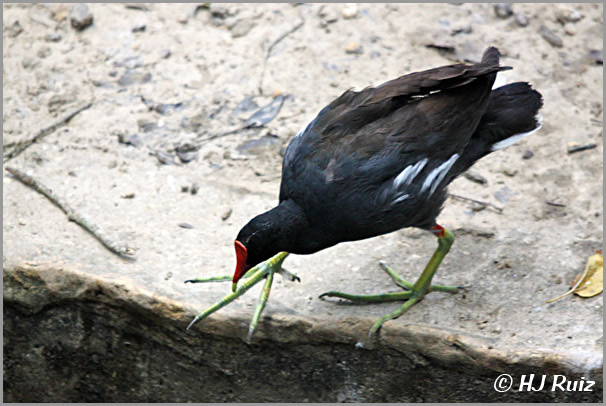
Photographs are © H. J. Ruiz – “My Backyard Visitors”
Text is available under the Creative Commons Attribution-ShareAlike License; additional terms may apply. See Terms of Use for details.


 H.J. Ruiz - Avian101
You must be logged in to post a comment.