Wood Duck a.k.a Carolina Duck
Wood Duck or Carolina Duck – Spec.Name: Aix Sponsa
This is a species of duck found in North America. It is one of the most colourful of North American waterfowl.
The Wood Duck is a medium-sized perching duck. A typical adult is from 47 to 54 cm (19 to 21 in) in length with a wingspan of between 66 to 73 cm (26 to 29 in). This is about three-quarters of the length of an adult Mallard. It shares its genes with the Asian Mandarin Duck (Aix galericulata).
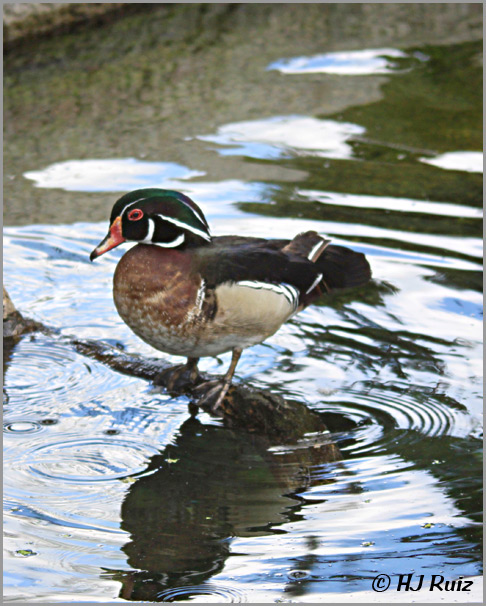
Wood Duck
The adult male has distinctive multicoloured iridescent plumage and red eyes,with a distinctive white flare down the neck. The female, less colourful, has a white eye-ring and a whitish throat. Both adults have crested heads. When swimming, Wood Ducks bob their head back and forth in a jerking motion, which makes them easy to spot.
The male’s call is a rising whistle, “jeeeeee”; the females utter a drawn-out, rising squeal, “oo-eek,” when flushed, and a sharp “cr-r-ek, cr-e-ek” for an alarm call.
Their breeding habitat is wooded swamps, shallow lakes, marshes or ponds, and creeks in eastern North America, the west coast of the United States and western Mexico. They usually nest in cavities in trees close to water, although they will take advantage of nesting boxes in wetland locations if available. Females line their nests with feathers and other soft materials, and the elevation provides some protection from predators. Unlike most other ducks, the Wood Duck has sharp claws for perching in trees and can, in southern regions, produce two broods in a single season—the only North American duck that can do so.
Females typically lay between 7 and 15 white-tan eggs that incubate for an average of 30 days. However, if nesting boxes are placed too close together, females may lay eggs in the nests of their neighbours, which may lead to nests which may contain as many as 40 eggs and unsuccessful incubation, a behaviour known as “nest dumping”
After hatching, the ducklings jump down from the nest tree and make their way to water. The mother calls them to her, but does not help them in any way. The ducklings may jump from heights of up to 88 metres (290 ft) without injury. They prefer nesting over water so the young have a soft landing, but will nest up to 140 m (150 yd) away from the shoreline. The day after they hatch, the young climb to the nest entrance and jump to the ground. The ducklings can swim and find their own food by this time.
These birds feed by dabbling or walking on land. They mainly eat berries, acorns, and seeds, but also insects, making them omnivores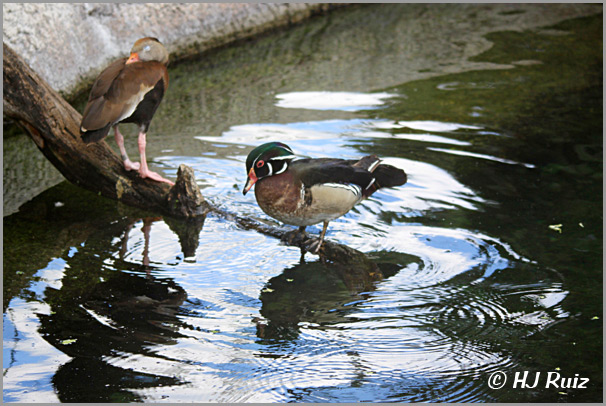
Photographs are © H.J. Ruiz – “My Backyard Visitors”
Text is available under the Creative Commons Attribution-ShareAlike License; additional terms may apply. See Terms of Use for details.


 H.J. Ruiz - Avian101
You must be logged in to post a comment.