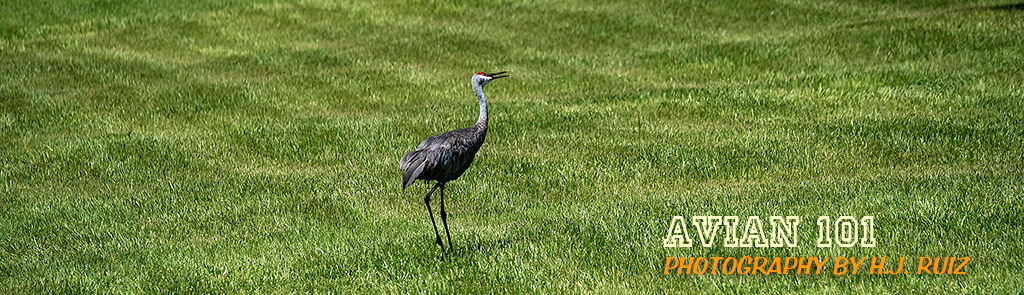
Green Heron
Green Heron – Spec. Name: Butorides Virescens
This is a small heron of North and Central America. It was long considered conspecific with its sister species the Striated Heron (Butorides striata), and together they were called “Green-backed Heron”. Birds of the nominate subspecies (no matter which taxonomic arrangement is preferred) are extremely rare vagrants to western Europe; individuals from the Pacific coast of North America may similarly stray as far as Hawaii.
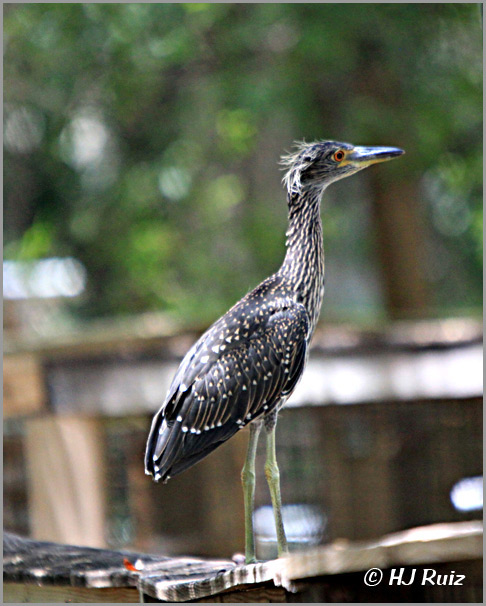
Green Heron (Immature)
The Green Heron is relatively small; adult body length is about 44 cm (17 in). The neck is often pulled in tight against the body. Adults have a glossy, greenish-black cap, a greenish back and wings that are grey-black grading into green or blue, a chestnut neck with a white line down the front, grey underparts and short yellow legs. The bill is dark with a long, sharp point. Female adults tend to be smaller than males, and have duller and lighter plumage, particularly in the breeding season. Juveniles are duller, with the head sides, neck and underparts streaked brown and white, tan-splotched back and wing coverts, and greenish-yellow legs and bill. Hatchlings are covered in down feathers, light grey above, and white on the belly.
The Green Heron’s call is a loud and sudden kyow; it also makes a series of more subdued kukcalls. During courtship, the male gives a raah-rahh call with wide-open bill, makes noisy wingbeats and whoom-whoom-whoom calls in flight, and sometimes calls roo-roo to the female before landing again. While sitting, an aaroo-aaroo courtship call is also given.
Green Herons are seasonally monogamous. The pairs form in the breeding range, after an intense courtship display by the males, who select the nesting sites and fly in front of the female noisily and with puffed-up head and neck plumage. They nest in forest and swamp patches, over water or in plants near water. Nests are a platform of sticks, often in shrubs or trees, sometimes on the ground. Locations in trees are preferred, with some nests built 20 meters off the ground; heights of several meters above ground are more common though. Rarely, large numbers of these birds congregate in heronries for nesting.
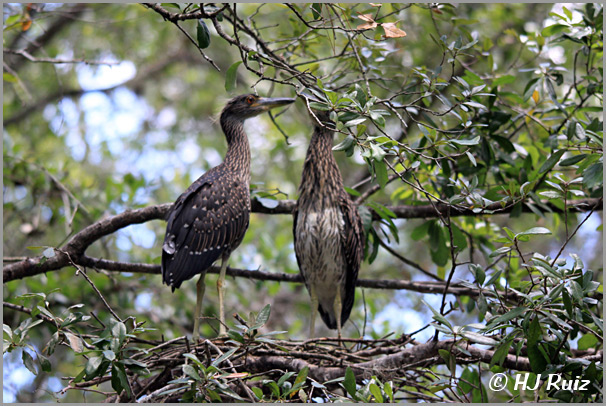
Green Herons at tree nest
Photographs are © H. J. Ruiz – “My Backyard Visitors”
Text is available under the Creative Commons Attribution-ShareAlike License; additional terms may apply. See Terms of Use for details.


 H.J. Ruiz - Avian101
You must be logged in to post a comment.