Saddle-billed Stork
Saddle-billed Stork – Spec. Name: Ephippiorhynchus Senegalensis
This is a large wading bird in the stork family, Ciconiidae. It is a widespread species which is a resident breeder in sub-Saharan Africa from Sudan, Ethiopia and Kenya south to South Africa, and in The Gambia, Senegal, Côte d’Ivoire and Chad in west Africa.

Saddle-billed Stork
This is a close relative of the widespread Asian Black-necked Stork, the only other member of the genus Ephippiorhynchus.
This is a huge bird that regularly attains a height of 150 cm (5 feet) and a 270 cm (9 feet) wingspan. The male is larger and heavier than the female, with a range of 5.1-7.5 kg, the female is usually between 5 and 6.9 kg. It is probably the tallest, if not the heaviest, of the storks. Females are distinctly smaller than the males. The sexes can be readily distinguished by the golden yellow irises of the female and the brown irises of the male.
It is spectacularly plumaged, identical in male and female. The head, neck, back, wings, and tail are iridescent black, with the rest of the body and the primary flight feathers being white. Juveniles are browner grey in plumage. The massive bill is red with a black band and a yellow frontal shield (the “saddle”). The legs and feet are black with pink knees. On the chest is a bare red patch of skin, whose colour darkens during breeding season.
They are silent except for bill-clattering at the nest. Like most storks, these fly with the neck outstretched, not retracted like a heron; in flight, the large heavy bill is kept drooping somewhat below belly height, giving these birds a very unusual appearance to those who see them for the first time. To experienced birdwatchers on the other hand, this makes them easily recognizable even if seen from a distance. It has been suggested that due to the large size and unusual appearance in flight, this species is the basis for the “Big Bird” and Kongamato cryptids.
The Saddle-billed Stork, like most of its relatives, feeds mainly on fish, frogs and crabs, but also on small birds and reptiles . They move in a deliberate and stately manner as they hunt, in a similar way to the larger herons.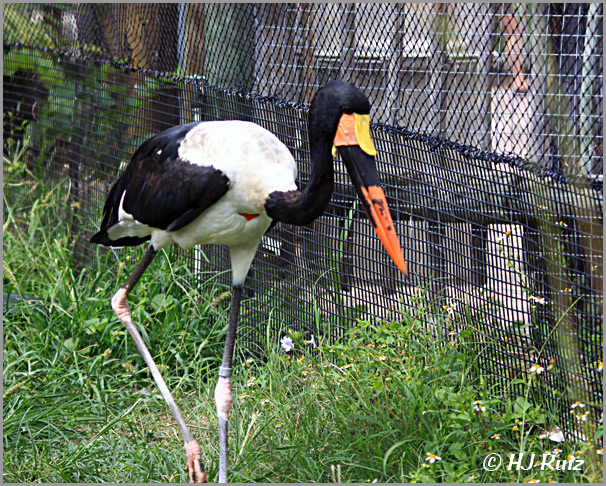
Photographs are © H. J. Ruiz – “My Backyard Visitors”
Text is available under the Creative Commons Attribution-ShareAlike License; additional terms may apply. See Terms of Use for details


 H.J. Ruiz - Avian101
You must be logged in to post a comment.