
American White Ibis
American White Ibis – Spec. Name: Eudocimus Albus
This is a species of wading bird in the ibis family Threskiornithidae. It occurs from the mid-Atlantic and Gulf coast of the United States south through most of the New World tropics.
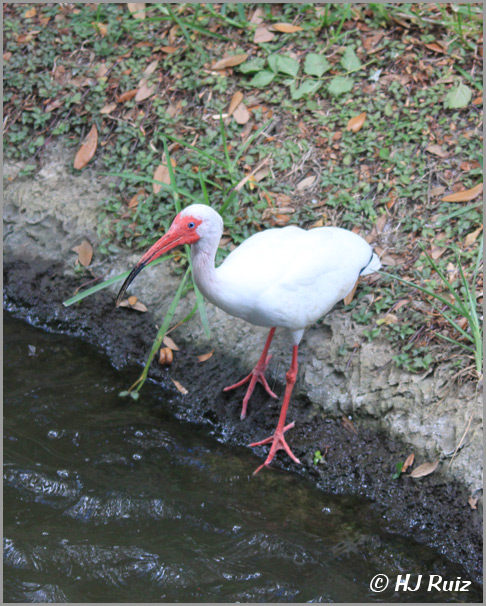
American White Ibis
The American White Ibis is a middle-sized bird with an overall white plumage, bright red-orange down-curved bill and long legs, and black wing tips that are usually only visible in flight. Being sexually dimorphic, males are larger than females. American White Ibises interbreed with Scarlet Ibises where their ranges overlap, and they have been classified as a single species. The breeding range of the American White Ibis spans along the Gulf and Atlantic Coast and also along the coasts of Mexico and Central America. The non-breeding range extends further inland in North America and also includes the Caribbean.
An adult American White Ibis weighs around 2 lb. and has an average length of about 26 in. with a 37 in. wingspan. It has an all-white plumage with thin black wingtips that are usually only visible in flight. The long, downcurved bill and long legs are bright red-orange. The sexes look alike, and it is difficult to determine the sex of an adult American White Ibis by visual observation. However, there is some sexual dimorphism in size — males average significantly larger than females, in terms of flight structure, bill size and weight. The American White Ibis has been found to be most dimorphic in terms of weight and least dimorphic in terms of flight structure. Like other species of ibis, the White Ibis flies with neck and legs outstretched, often in long, loose lines.
The juvenile American White Ibis is structurally like an adult, but it has largely brown plumage and only the rump, underwing and underparts are white. The bill and legs are light orange. As it matures, white feathers begin appearing on the back and it undergoes a gradual molt to obtain the white adult plumage.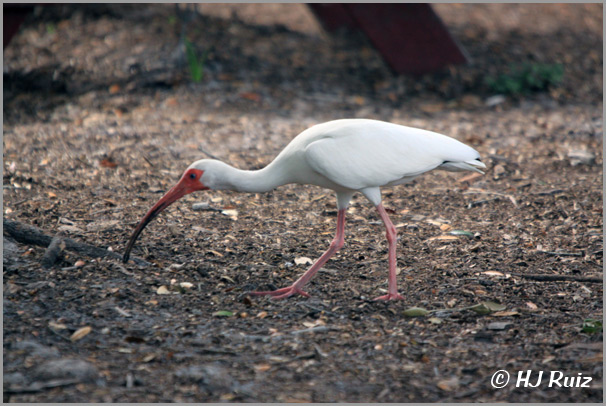
In North America, the White Ibis breeds coastally along the Gulf Coast. It is common across Florida and occurs inland in the state as well. It has also been found to breed along the Atlantic coast, reaching as far north as the Carolinas. The non-breeding range of the White Ibis extends further inland, reaching north to Virginia, and west to eastern Texas. The White Ibis is known to wander, and has been sighted, sometimes in small flocks, in states far out of its usual range. The species is most common in Florida, where over 30,000 have been counted in a single breeding colony. It also occurs throughout the Caribbean, on both coasts of Mexico and Central America, and as far south as Columbia and Venezuela.
Outside the nesting season, the White Ibis’s habitat selection is highly variable although shallow coastal marshes, wetlands, and mangrove swamps are the preferred habitat. The White Ibis is also commonly found in muddy pools, on mudflats and even wet lawns. White Ibis populations that are away from the coast and shoreline, particularly in southern Florida, often reside in other forms of wet habitats such as marshes, ponds and flooded fields.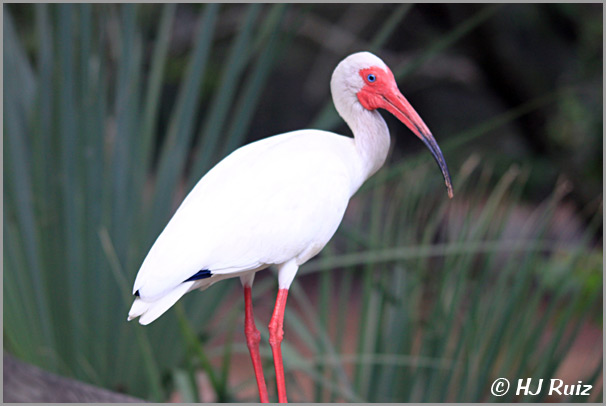
Photographs are © H. J. Ruiz – “My Backyard Visitors” Taken in Tampa and Sarasota, Florida.
Text is available under the Creative Commons Attribution-ShareAlike License; additional terms may apply. See Terms of Use for details.
Wikipedia® is a registered trademark of the Wikimedia Foundation, Inc., a non-profit organization.



 H.J. Ruiz - Avian101
You must be logged in to post a comment.