
Great Blue Heron
Great Blue Heron – Spec. Name: Ardea Herodias
It is the largest North American heron, with a head-to-tail length of 91–140 cm (36–55 in), a wingspan of 167–201 cm (66–79 in), and a weight of 2–3.6 kg (4.4-8 lbs). Notable features include slaty flight feathers, red-brown thighs, and a paired red-brown and black stripe up the flanks; the neck is rusty-gray, with black and white streaking down the front; the head is paler, with a nearly white face, and a pair of black plumes running from just above the eye to the back of the head. The feathers on the lower neck are long and plume-like; it also has plumes on the lower back at the start of the breeding season. The bill is dull yellowish, becoming orange briefly at the start of the breeding season, and the lower legs gray, also becoming orangey at the start of the breeding season. Immature birds are duller in color, with a dull blackish-gray crown, and the flank pattern only weakly defined; they have no plumes, and the bill is dull gray-yellow.
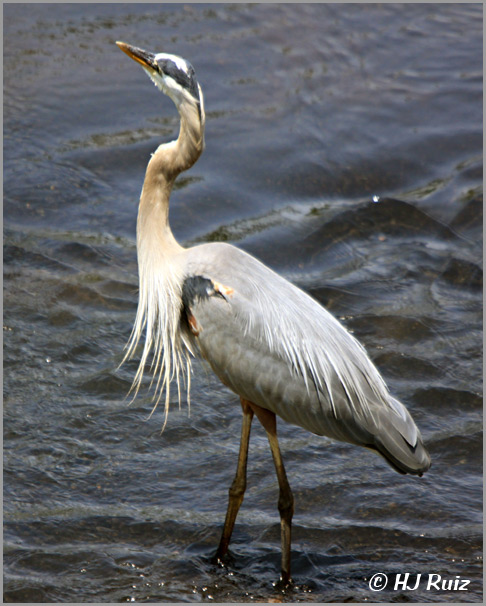
Great Blue Heron
The heron stride is around 22 cm (9 in), almost in a straight line. Two of the three front toes are generally closer together. In a track the front toes as well as the back often show the small talons.
The subspecies differ only slightly in size and plumage tone, with the exception of subspecies occidentalis, which as well as normal colored birds, also has a distinct white morph, known as the Great White Heron (not to be confused with the Great Egret, for which “Great White Heron” was once a common name). It is found only in south Florida and some parts of the Caribbean. The Great White Heron differs from other Great Blues in bill morphology, head plume length, and in having a total lack of pigment in its plumage. This is mainly found near salt water, and was long thought to be a separate species. Birds intermediate between the normal morph and the white morph are known as Würdemann’s Heron; these birds resemble a “normal” Great Blue with a white head.
The theory that Great White Heron may be a separate species from Great Blue Heron has again been given some support by David Sibley.
The “Great White Heron” could be confused with Great Egret but is larger, with yellow legs as opposed to the Great Egret’s black legs. The Reddish Egret and Little Blue Heron could be mistaken for the Great Blue Heron, but are much smaller, and lack white on the head and yellow in the bill. In the southern reaches of its range, the Great Blue sometimes overlaps in range with the closely-related and similarly-sized Cocoi Heron. The Cocoi is distinguished by a striking white neck and solid black crown, but the duller juveniles are more easily confused. More superficially similar is the slightly smaller Grey Heron, which may sometimes vagrate to the Northern coasts of North America. The Grey (which occupies the same ecological niche in Eurasia as the Great Blue Heron) has very similar plumage but has a solidly soft-gray neck. Erroneously, the Great Blue Heron is sometimes referred to as a “crane”.
Diet
The primary food for Great Blue Heron is small fish, though it is also known to opportunistically feed on a wide range of shrimp, crabs, aquatic insects, rodents and other small mammals,amphibians, reptiles, and small birds. Herons locate their food by sight and usually swallow it whole. Herons have been known to choke on prey that is too large. It is generally a solitaryfeeder. Individuals usually forage while standing in water, but will also feed in fields or drop from the air, or a perch, into water. As large wading birds, Great Blue Herons are able to feed in deeper waters, and thus are able to harvest from niche areas not open to most other heron species.
It feeds in shallow water or at the water’s edge during both the night and the day, but especially around dawn and dusk. It uses its long legs to wade through shallow water, and spears fish or frogs with its long, sharp bill.

All photographs are © H. J. Ruiz -“My Backyard Visitors”
Text is available under the Creative Commons Attribution-ShareAlike License; additional terms may apply. See Terms of Use for details.
Wikipedia® is a registered trademark of the Wikimedia Foundation, Inc., a non-profit organization.



 H.J. Ruiz - Avian101
I know this website offers quality dependent articles or
reviews and other stuff, is there any other web page which gives such stuff
in quality?
I’m sure there must be some, I wouldn’t know I only care for my own.:)