Albino Peafowl
Albino Peafowl a.k.a. White Peafowl – Spec.Name: Pavo Cristatus mut. Alba
The term peafowl can refer to the two species of bird in the genus Pavo of the pheasant family, Phasianidae. The African Congo Peafowl is placed in its own genus Afropavo and is not dealt with here. Peafowl are best known for the male’s extravagant tail, which it displays as part of courtship. The male is called a peacock, and the female a peahen. The female peafowl is brown or toned grey and brown.
The two species are:
- Indian Peafowl, Pavo cristatus, a resident breeder in South Asia. The peacock is designated as the national bird of India and the provincial bird of the Punjab.
- Green Peafowl, Pavo muticus. Breeds from Burma east to Java. The IUCN lists the Green Peafowl as vulnerable to extinction due to hunting and a reduction in extent and quality of habitat.
Plumage
The male (peacock) Indian Peafowl has iridescent blue-green or green colored plumage. The peacock tail (“train”) is not the tail quill feathers but the highly elongated upper tail coverts. The “eyes” are best seen when the peacock fans its tail. Both species have a crest atop the head. The female (peahen) Indian Peafowl has a mixture of dull green, brown, and grey in her plumage. She lacks the long upper tail coverts of the male but has a crest. The female can also display her plumage to ward off female competition or signal danger to her young.
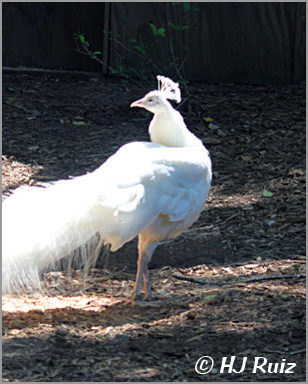
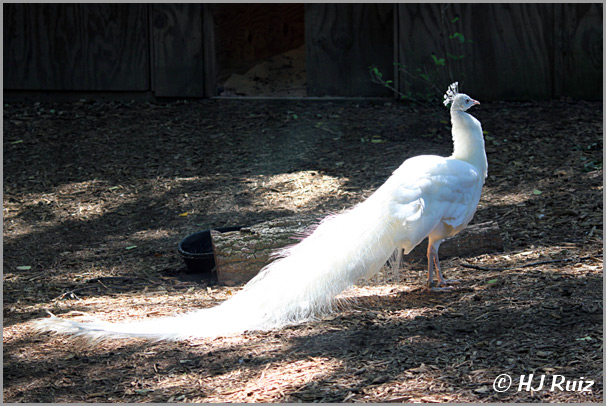
Albino Peafowl (Peacock)
The Green Peafowl appears different from the Indian Peafowl. The male has green and gold plumage and has an erect crest. The wings are black with a sheen of blue. Unlike the Indian Peafowl, the Green Peahen is similar to the male, only having shorter upper tail coverts and less iridescence. It is difficult to tell a juvenile male from an adult female.
As with many birds, vibrant plumage colours are not primarily pigments, but optical interference Bragg reflections, based on regular, periodic nanostructures of the barbules (fiber-like components) of the feathers. Slight changes to the spacing result in different colours. Brown feathers are a mixture of red and blue: one colour is created by the periodic structure, and the other is a created by a Fabry–Pérot interference peak from reflections from the outer and inner boundaries. Such interference-based structural colour is important for the peacock’s iridescent hues that change and shimmer with viewing angle, since unlike pigments, interference effects depend on light angle.
Colour mutations exist through selective breeding, such as the leucistic White Peafowl and the Black-Shouldered Peafowl.
The peafowl are forest birds that nest on the ground but roost in trees. They are terrestrial feeders.
Both species of Peafowl are believed to be polygamous. However, it has been suggested that “females” entering a male Green Peafowl’s territory are really his own juvenile or sub-adult young (K. B. Woods in lit. 2000) and that Green Peafowl are really monogamous in the wild. The male peacock flares out his feathers when he is trying to get the female’s attention.
During the mating season they will often emit a very loud high pitched cry.
Peafowl are omnivorous and eat most plant parts, flower petals, seed heads, insects and other arthropods, reptiles, and amphibians.
In common with other members of the Galliformes, males possess metatarsal spurs or “thorns” used primarily during intraspecific fights.
Peafowl have left captivity and developed permanent, free-roaming populations in several parts of the world including India.
Photographs are © H. J. Ruiz – “My Backyard Visitors”
Text is available under the Creative Commons Attribution-Share Alike License; additional terms may apply. See Terms of Use for details.
Wikipedia® is a registered trademark of the Wikimedia Foundation, Inc., a non-profit organization.


 H.J. Ruiz - Avian101
You must be logged in to post a comment.