
Toco Toucan
Toco Toucan – Spec. Name: Ramphastos Toco
This is the largest and arguably best known species in the toucan family. It is found in semi-open habitats throughout a large part of central and eastern South America. It is a common attraction in zoos.
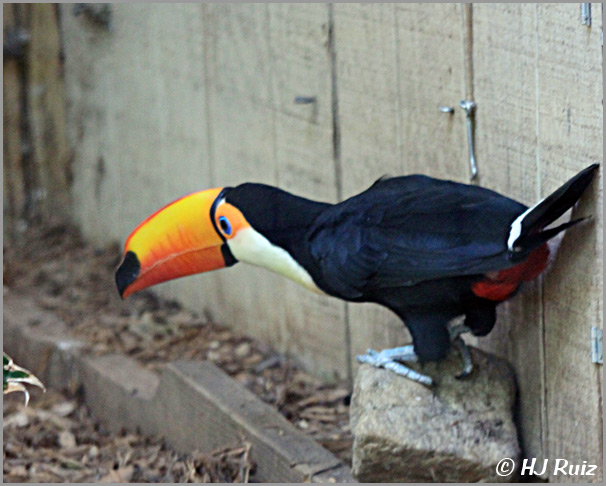
Toco Toucan
The Toco Toucan has a striking plumage with a mainly black body, a white throat, chest and uppertail-coverts, and red undertail-coverts. What appears to be a blue iris is actually thin blue skin around the eye. This blue skin is surrounded by another ring of bare, orange skin. The most noticeable feature, however, is its huge bill, which is yellow-orange, tending to deeper reddish-orange on its lower sections and culmen, and with a black base and large spot on the tip. It looks heavy, but as in other toucans it is relatively light because the inside largely is hollow. The tongue is nearly as long as the bill and very flat. With a total length of 55–65 cm (22–26 in), incl. a bill that measures almost 20 cm (8 in), and a weight of 500–860 g (17.5-30 oz), it is the largest species of toucan and the largest representative of the order Piciformes. Males are larger than females, but otherwise both are alike. Juveniles are duller and shorter-billed than adults. Its voice consists of a deep, coarse croaking, often repeated every few seconds. It also has a rattling call and will bill-clack.
It is, unlike the other members of the genus Ramphastos, essentially a non-forest species. It can be found in a wide range of semi-open habitats such as woodland, savanna and other open habitats with scattered trees, Cerrado, plantations, forest-edge, and even wooded gardens. It is mainly a species of lowlands, but occurs up to 1750 m (5750 ft) near the Andes in Bolivia. Because it prefers open habitats it is likely to benefit from the widespread deforestation in tropical South America. It has a large range and except in the outer regions of its range, it typically is fairly common. It is therefore considered to be of Least Concern by Bird Life International. It is easily seen in the Pantanal.
The bill is largest beak relative to body size of all birds providing 30 to 50% of its body surface area. It was called by Buffon a “grossly monstrous” appendage. Diverse functions have been suggested. Charles Darwin suggested it was a sexual ornament: “toucans may owe the enormous size of their beaks to sexual selection, for the sake of displaying the diversified and vivid stripes of colour with which these organs are ornamented”. Further suggestions have included aid in peeling fruit, intimidating other birds when robbing their nests, social selection related to defense of territory, and as a visual warning.
Research has shown that one function is as a surface area for heat exchange. The bill has the ability to modify blood flow and so regulate heat distribution in the bird, allowing it to use its bill as a thermal radiator. In terms of surface area used for this function, the bill relative to the bird’s size is amongst the largest of any animal and has a network of superficial blood vessels supporting the thin horny sheath on the bill made of keratin called the rhamphotheca.
In its capacity to remove body heat the bill is comparable to that of elephant ears. The ability to radiate heat depends upon air speed: if this is low only 25% of the adult bird’s resting heat production to as much as four times this heart production. In comparison the bill of a duck and the ears of elephant can shed only 9 to 91% of resting heat production. The bill normally is responsible for 30 to 60% of heat loss. The practice of Toco Toucan’s of placing their bills under their wings may serve to insulate the bill and reduce heat loss during sleep. It has been observed that “complexities of the vasculature and controlling mechanisms needed to adjust the blood flow to the bill may not be completely developed until adulthood.”

Photographs are © H. J. Ruiz – “My Backyard Visitors”
Text is available under the Creative Commons Attribution-ShareAlike License; additional terms may apply. See Terms of Use for details.
Wikipedia® is a registered trademark of the Wikimedia Foundation, Inc., a non-profit organization.



 H.J. Ruiz - Avian101
You must be logged in to post a comment.