
Verreaux’s Eagle-Owl a.k.a. Milky Eagle Owl
Verreaux’s Eagle-Owl a.k.a. Milky Eagle Owl – Spec. Name: Bubo Lacteus
This owl is a member of the family Strigidae and is the largest African owl. This owl is claimed to be the world’s third largest owl; after the Blakiston’s Fish Owl and Eurasian Eagle Owl.
Verreaux’s Eagle-owl ranges from 66–75 cm (26-30 in) in length. This species can attain a wingspan 2 m (6.5 ft) and weighs from 1600 to 3115 grams (equal to 3.5 to 7 pounds). In appearance, they are distinguished by a whitish oval disk face with a black border, pink eyelids, orange eyes and two feather tufts on their ears. Their feathers are dark brown on top and light grey below.
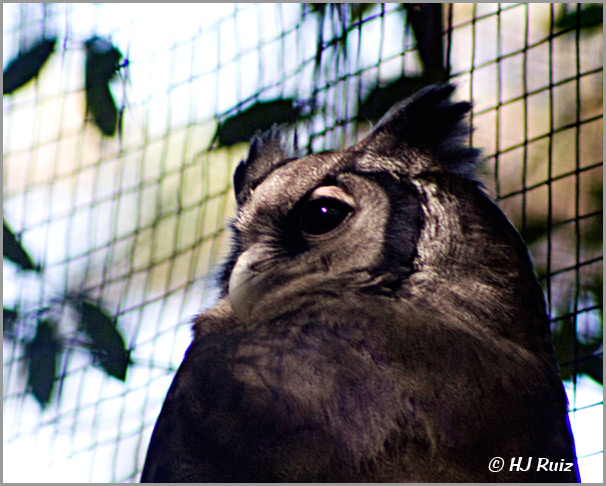
Verreaux's Eagle-Owl - aka (Milky Eagle Owl)
They are nocturnal birds and roost in tall trees. They sleep lightly and will awaken very quickly to defend themselves from attack in daylight hours.
They hunt in early evening. Full-grown owls feed on hares, mongoose and many other small game animals. They are one of the very few birds to feed on hedgehogs. Near cities their prey include rats and pigeons.
Breeding takes place from March to September. The female lays two eggs and incubates them for thirty-eight days. She remains on the nest for the entire incubation period while the male hunts for food for both of them. The first egg to hatch is the first to be fed, and if food is not plentiful only the first one hatched will be fed. If food is abundant, both owlets will be fed. The chicks are ready to leave the nest at nine weeks but may remain with the parents for up to three months.
Photograph © H. J. Ruiz – “My Backyard Visitors”
Text is available under the Creative Commons Attribution-ShareAlike License; additional terms may apply. See Terms of Use for details.
Wikipedia® is a registered trademark of the Wikimedia Foundation, Inc., a non-profit organization.


 H.J. Ruiz - Avian101
You must be logged in to post a comment.