
Eastern Kingbird
I’m very happy to add another species of bird visiting my backyard. It makes me so proud to introduce:
Eastern Kingbird – Spec.Name: Tyrannus Tyrannus
This is a large Tyrant flycatcher. Adults are grey-black on the upperparts with light underparts; they have a long black tail with a white end and long pointed wings. They have a red patch on their crown, seldom seen. They are of average size for a kingbird, at 19–23 cm (7.5–9 in), 33–38 cm (13–15 in) across the wings and weighing 33-55 g (1.2-1.9 oz).
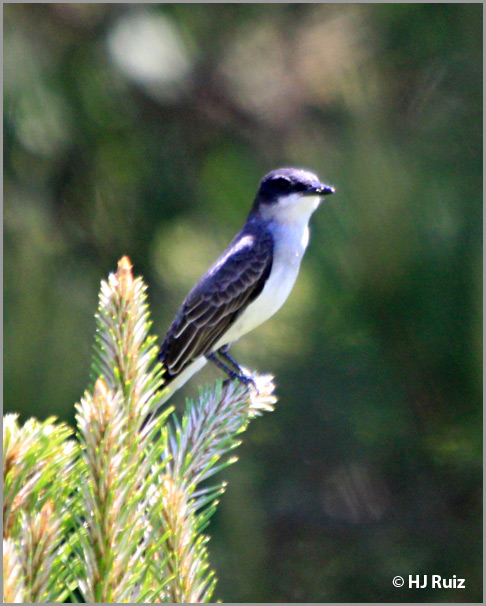
Eastern Kingbird
The call is a high-pitched, buzzing and unmusical chirp, frequently compared to an electric fence.
Their breeding habitat is open areas across North America. They make a sturdy cup nest in a tree or shrub, sometimes on top of a stump or pole. These birds aggressively defend their territory, even against much larger birds.
These birds migrate in flocks to South America.
They wait on an open perch and fly out to catch insects in flight, sometimes hovering to pick food off vegetation. They also eat berries and fruit, mainly in their wintering areas.
Some Eastern Kingbirds place their nests in the open while others hide nests very well. Eastern Kingbirds in Southern British Columbia can nest in open fields; in shrubs over open water; high in tall trees and even in the tops of small stumps. It has been shownthat those pairs that hide their nests well tend to be less aggressive towards intruders near the nest (perhaps relying on nest cover), while pairs that nest in the open tend to be more overtly aggressive to intruders. Both male and female participate in nest defense, but females may stay on well-hidden nests longer than females with open nests who may leave nests earlier to chase away predators. Those pairs nesting in the open may be able to see predators coming earlier and rely on aggressive behavior to protect their young.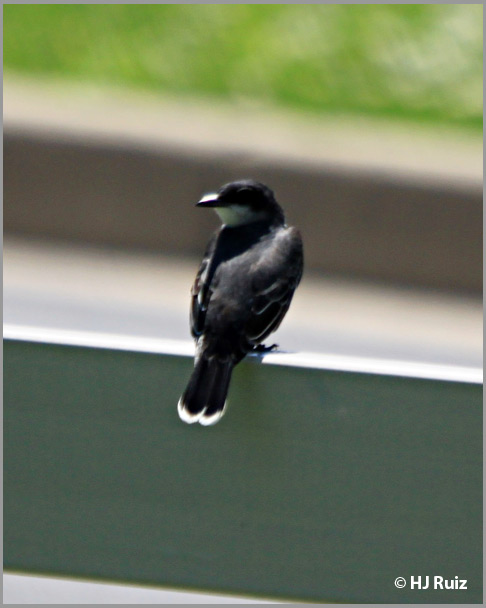
The aggressive behavior of Eastern Kingbirds has been shown to keep ravens and crows from finding experimental nests placed near kingbird nests. Similar experimental nests placed far from the kingbird nests were found far more often by crows and ravens. They can also recognize and remove cowbird eggs from their nests. Still, blue jays, american crows, squirrels and tree-climbing snakes are occasion nest predators. American kestrel are probable predators of adults.
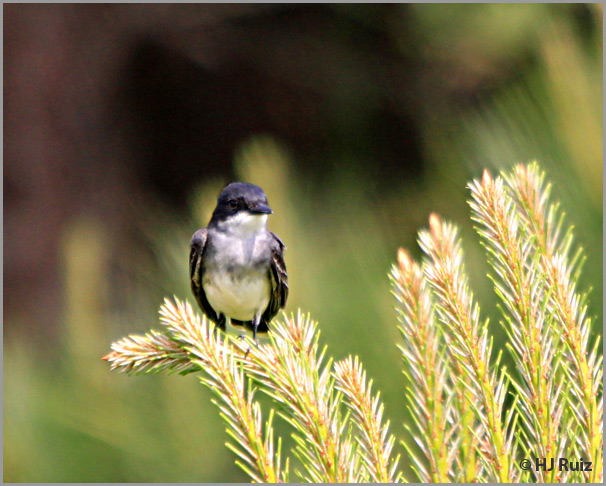
Photographs are © 2011 H.J. Ruiz “My backyard Visitors”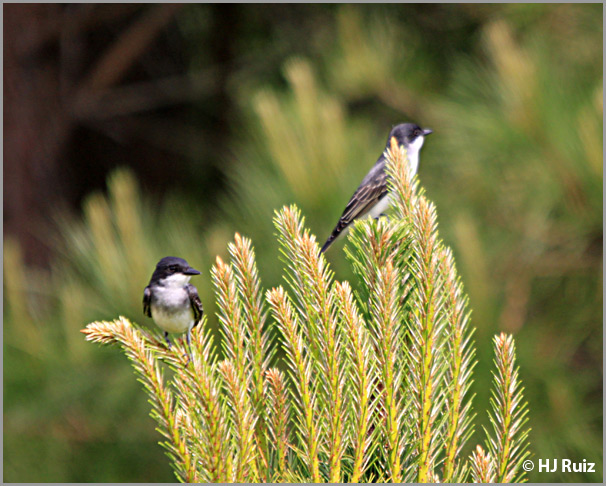
 Text is available under the Creative Commons Attribution-ShareAlike License; additional terms may apply. See Terms of Use for details.
Wikipedia® is a registered trademark of the Wikimedia Foundation, Inc., a non-profit organization.


 H.J. Ruiz - Avian101
You must be logged in to post a comment.