
Inca Tern
Inca Tern – Spec.Name: Larosterna Inca
These birds are found along the Pacific coast from northern Peru south to central Chile. Mass dispersal and breeding failures have resulted periodically from El Niño Southern Oscillation (ENSO) events, and both fish-stocks and the populations of seabirds that depend upon them are adapted to these fluctuations. Population declines are usually promptly reversed, suggesting that food shortages trigger rapid dispersal not high mortality in adults and high reproduction rates (up to two successful broods in a year). Although fishing for anchoveta has been banned in Peru, and the guano industry adequately regulated, there are concerns that this species might be badly affected by the El Niño Southern Oscillation event of 19981. Prior to the guano industry (c.1850) there were millions of Inca Terns in Peru (according to accounts from Coker 1919, Hutchison 1950). Current numbers are much lower than two centuries ago, but they are common and breed in some localities. The total population has been estimated at more than 150,000 individuals.
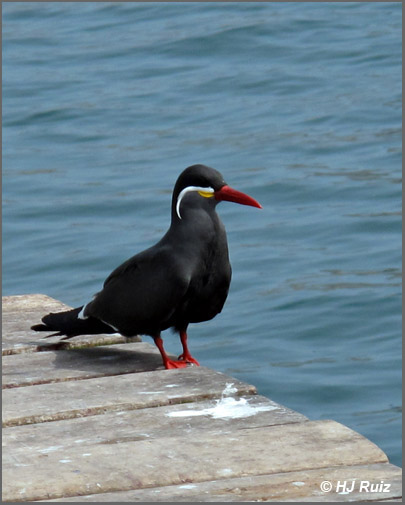
Inca Tern
Habitat and Ecology: It breeds on inshore (and occasionally offshore) islands and rocky coastal cliffs. Nests are placed in suitable fissures, burrows, caves and cavities, sometimes the old nest of a Humboldt Penguin Spheniscus humboldti. It feeds, often in large flocks, on schooling anchoveta Engraulis ringens, mote sculpins Normanychtic crokeri and silversides Odothestes regia regia found in the cold water of the Humboldt Current. Additionally, this species scavenges offal and scraps from sea-lions and fishing boats. One or two eggs are incubated for about four weeks, and the chicks leave the nest after seven weeks. Birds feed by plunge diving for fish.
Native:
Chile; Colombia; Ecuador; Peru
Vagrant:
Panama
Note: The photo displayed above was shot at Port of Ancon, Peru by H.J. Ruiz




 H.J. Ruiz - Avian101
You must be logged in to post a comment.