
Know about ancient birds: Confuciusornis
Confuciusornis
Is a genus of primitive crow-sized birds from the Early Cretaceous Yixian and Jiufotang Formations of China, dating from 125 to 120 million years ago. Like modern birds, Confuciusornis had a toothless beak, but close relatives of modern birds such as Hesperornis and Ichthyornis were toothed, indicating that the loss of teeth occurred convergently in Confuciusornis and living birds. It is the oldest known bird to have a beak. It was named after the Chinese moral philosopher Confucius (551–479 BCE). Confuciusornis is one of the most abundant vertebrates found in the Yixian Formation, and several hundred complete, articulated specimens have been found. Confuciusornis was about the size of a modern pigeon, with a wingspan of up to 0.7 meters (2.3 ft) and a weight of up to 0.5 kilograms. Fossils of Confuciusornis show that it had an exceptionally large humerus (upper arm bone), and a characteristic hole near its shoulder-end may have reduced the bone’s weight. The furcula or wishbone was a simple bar, like that of Archaeopteryx. The sternum (breastbone) was relatively large and had a low keel which was raised at the back end. This bony keel may or may not have anchored a larger, cartilaginous, keel for enlarged pectoral muscles. The scapula (shoulder blades) were fused to the coracoid bones and may have formed a solid base for the attachment of wing muscles. The orientation of the shoulder joint was sideways, instead of angled upward as in modern birds; this means thatConfuciusornis was unable to lift its wings above its back. Like Archaeopteryx, it was thus incapable of the upstroke required for flapping flight.
Confuciusornis was more advanced than Archaeopteryx in possessing a short tail with a pygostyle (a bone formed from a series of short, fused tail vertebrae), but more primitive than modern birds in retaining large claws on the forelimbs, a primitive skull, and relatively small breastbone. The proportions of the toes suggest that they were used for both walking and perching, while the large claws of the thumb and third finger were probably used for climbing. The head probably had a small crest or tuft similar to that in today’s mousebirds or turacos.
Feathers and flight
The wing feathers of Confuciusornis were long and modern in appearance. The primary wing feathers of a 0.5 kilogram individual reached 20.7 centimeters in length, about the same proportions as in the Common Wood Pigeon, which is similar in size and overall wingspan. The longest primary feathers (remiges) were more than three times the length of the hand and relatively longer than those of any living bird, while the secondary feathers were rather short by comparison. Thus, the wing shape was very unlike that of living birds, being long and narrow. In 2010, Nudds and Dyke published a study arguing that in both Confuciusornis and Archaeopteryx, the rachis(central shaft) of the primary feathers were too thin and weak to have remained rigid during the power strokes required for true flight.
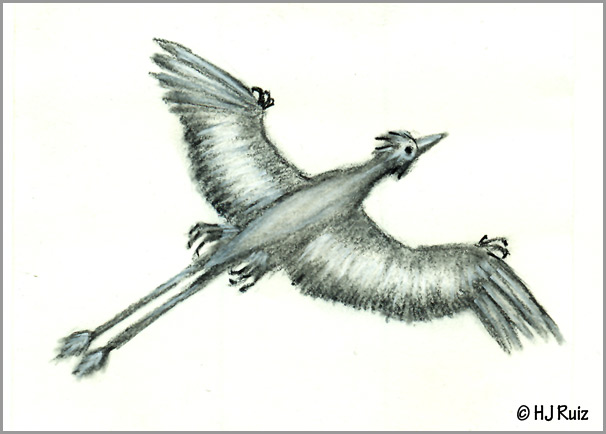
Confuciusornis - Graphic © HJ Ruiz
Instead, they argued, Confuciusorniswould have employed gliding flight, which is also consistent with the unusual adaptations seen in its upper arm bones. Gregory Paul, however, disagreed with their study. He argued that Nudds and Dyke had overestimated the weights of these early birds, and that more accurate weight estimates allowed powered flight even with relatively narrow rachises. Nudds and Dyke assumed a weight of 1.5 kilograms for Confuciusornis, as heavy as the modern teal. Paul argued that a more reasonable body weight estimate is about 180 grams, less than that of a pigeon. Paul also noted that Confuciusornis is commonly found as large assemblages in lake bottom sediments with little to no evidence of extensive postmortem transport, and that it would be highly unusual for gliding animals to be found in such large numbers in deep water. Rather, this evidence suggests that Confuciusornis traveled in large flocks over the lake surfaces, a habitat consistent with a flying animal.
Many individuals show long, streamer-like tail feathers that may indicate sexual dimorphism and could have been used in courtship display, but the rest of the tail feathers were small and probably of little use in flight.
Diet
There are immature specimens known, and from the analysis of bone growth patterns of young adults it has been estimated that Confuciusornis reached maturity somewhat slower than extant small birds, but faster than advanced dinosaurs (de Ricqlès et al., 2003), which might indicate an omnivorous diet similar to modern crows.
It has been hypothesized that Confuciusornis fed on plant materials due to its toothless beak, but no gastroliths or stomach contents had been reported (Zhou & Zhang, 2003). Dalsätt and colleagues (2006) described a specimen (IVPP V133) that preserves 7 to 9 vertebrae and several ribs of a fish (probably Jinanichthys). These fish bones are formed into a tight cluster about 6 millimeters across, and the cluster is in contact with the seventh and eighth cervical vertebrae of the bird. In this position it was likely in the crop of the bird, which may have been preparing to regurgitate a pellet when it died. No other fish remains are present in the slab. (Dalsätt et al., 2006).
The paradise kingfishers (genus Tanysiptera) of modern Australia and New Guinea have elongated “racket plumes” as their central tail feathers, giving them a superficial resemblance to Confuciusornis. These kingfishers also take fish as prey, but they are not specialized fishers. They take many insects and other small prey from their forest habitat.
Colouration
In early 2010, a group of scientists led by Zhang Fucheng examined fossils with preserved melanosomes (organelles which contain colors). By studying such fossils with an electron microscope, they found melanosomes preserved in a fossil Confuciusornis specimen, IVPP V13171. The melanosomes where of two types, eumelanosomes andpheomelanosomes. This indicates that Confuciusornis had hues of grey, red/brown and black, possibly something like the modern zebra finch. It was also the first time an early bird fossil has been shown to contain preserved pheomelanosomes.
Text is available under the Creative Commons Attribution-ShareAlike License; additional terms may apply. See Terms of Use for details.
Wikipedia® is a registered trademark of the Wikimedia Foundation, Inc., a non-profit organization.


 H.J. Ruiz - Avian101
constantly i used to read smaller articles which
as well clear their motive, and that is also happening
with this post which I am reading here.