
White-crowned Sparrow
White-crowned Sparrow – Spec.Name: Zonotrichia Leucophrys
This is a medium-sized sparrow native to North America.
Adults are 18 cm (7 in) long and have black and white stripes on their head, a grey face, brown streaked upper parts and a long tail. The wings are brown with bars and the underparts are grey. Their bill is pink or yellow. They are similar in appearance to the White-throated Sparrow but do not have the white throat markings.
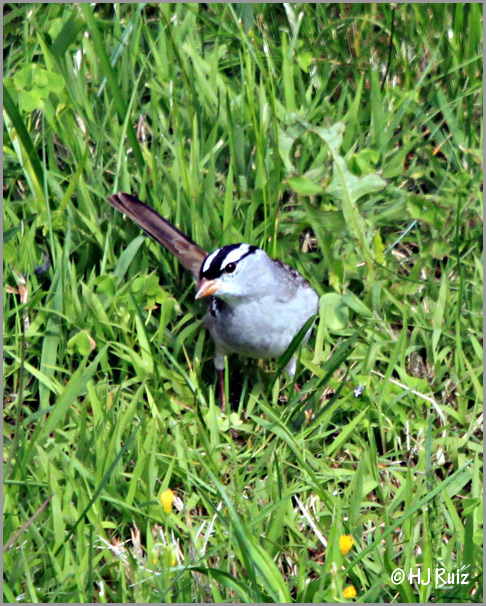
White-crowned Sparrow
Breeding
Their breeding habitat is brushy areas across northern Canada and the western United States. They nest either low in bushes or on the ground under shrubs and lay 3-5 brown-marked grey or greenish-blue eggs.
Subspecies
There are five currently recognized subspecies of white-crowned sparrow (pugetensis, gambelii, nuttalli, oriantha, and leucophrys), varying in migratory behaviour and breeding habitat. The Nuttall’s subspecies are permanent residents in California, while the Gambel’s subspecies may migrate as far as the Arctic Circle during the summer breeding season. Northern birds migrate to the southern United States.
Vagrancy
White-crowned Sparrow is a very rare vagrant to western Europe. One was present in County Cork, Ireland in May 2003. Another was found in Norfolk, England in January 2008. A young sparrow was also observed in Ona, Norway in October 2009. A young bird was seen in Surrey, England in May 2010.
Behavior
These birds forage on the ground or in low vegetation, but sometimes make short flights to catch flying insects. They mainly eat seeds, other plant parts and insects. In winter, they often forage in flocks.
Migration alertness
The White-crowned Sparrow is known for its natural alertness mechanism, which allows it to stay awake for up to two weeks during migration. This effect has been studied for possible human applications, such as shift-work drowsiness or truck driving.
Note:
From H.J. Ruiz (Avian101)
For the first time I’ve been able to photograph the White-crowned Sparrow in my backyard. At first I thought that it was the White-throated Sparrow from the distance. Then I noticed the lack of the yellow markings on the brow.
I’m very happy to add one more species of birds on my list.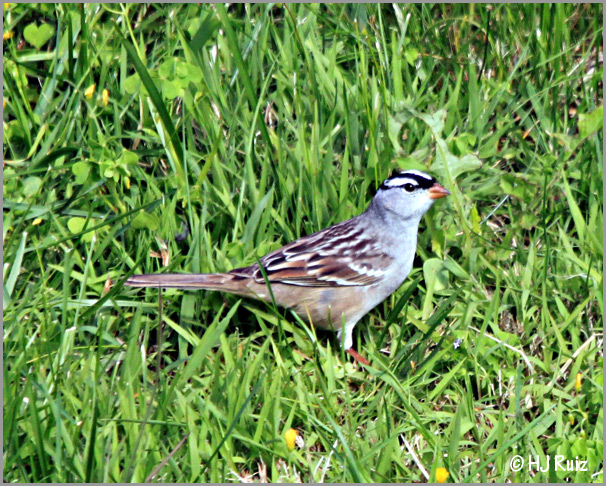


 H.J. Ruiz - Avian101
You must be logged in to post a comment.