Mallard
Mallard, or wild duck – Spec. Name: Anas Platyrhynchos
This is a dabbling duck which breeds throughout the temperate and subtropical Americas, Europe, Asia, and North Africa, and has been introduced to New Zealand and Australia.
The male birds have a bright green head, while the female’s is light brown. The Mallard lives in wetlands, eats water plants, and is gregarious. It is also migratory. The Mallard is the ancestor of all domestic ducks, and can interbreed with other species of genus Anas. However, a potentially terminal side effect of this vast interbreeding capability is gradual genetic dilution, which is causing rarer species of ducks to become at risk for extinction.
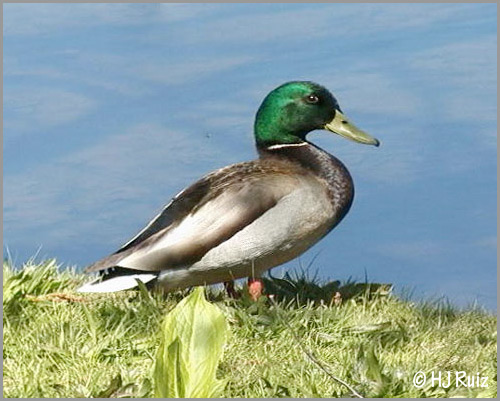
Mallard (M)
Taxonomy and evolution
The Mallard was one of the many bird species originally described by Linnaeus in his 18th century work, Systema Naturae, and still bears the first binomial name given to it.
The Mallard is the ancestor of almost all of the varieties of domestic ducks. Ducks belong to the subfamily Anatinae of the waterfowl family Anatidae. The wild Mallard and Muscovy duck (Cairina moschata) are believed to be the ancestors of all domestic ducks.
The name is derived from the Old French malart or mallart “wild drake”, although its ultimate derivation is unclear. It may be related to an Old High German masculine proper name Madelhart, clues lying in the alternate English forms “maudelard” or “mawdelard”.
Mallards frequently interbreed with their closest relatives in the genus Anas, such as the American Black Duck, and also with species more distantly related, for example the Northern Pintail, leading to various hybrids that may be fully fertile. This is quite unusual among different species, and apparently is because the Mallard evolved very rapidly and not too long ago, during the Late Pleistocene only. The distinct lineages of this radiation are usually kept separate due to non-overlapping ranges and behavioural cues, but are still not fully genetically incompatible. Mallards and their domesticated conspecifics are, of course, also fully interfertile.
Mallards appear to be closer to their Indo-Pacific relatives than to their American ones judging from biogeography. Considering mtDNA D-loop sequence data, they may have evolved more probably than not in the general area of Siberia; Mallard bones rather abruptly appear in food remains of ancient humans and other deposits of fossil bones in Europe, without a good candidate for a local predecessor species. The large ice age paleosubspecies which made up at least the European and west Asian populations during the Pleistocene has been named Anas platyrhynchos palaeoboschas.

Two Mallards and a Pekin duck
Haplotypes typical of American Mallard relatives and Spotbills can be found in Mallards around the Bering Sea. The Aleutian Islandsturned out to hold a population of Mallards that appear to be evolving towards a subspecies, as gene flow with other populations is very limited.
The size of the Mallard varies clinally, and birds from Greenland, although larger than birds further south, have smaller bills and are stockier. It is sometimes separated as subspecies, the Greenland Mallard (A. p. conboschas).
The Mallard is 56–65 centimetres (22–26 in) long (of which the body makes up around two-thirds), has a wingspan of 81–98 centimetres (32–39 in), and weighs 0.9–1.2 kilograms (32–42 oz). The breeding male is unmistakable, with a bright bottle-green head, black rear end and a yellowish orange (can also contain some red) bill tipped with black (as opposed to the black/orange bill in females). It has a white collar which demarcates the head from the purple-tinged brown breast, grey brown wings, and a pale grey belly. The dark tail has white borders. The female Mallard is a mottled light brown, like most female dabbling ducks, and has buff cheeks, eyebrow, throat and neck with a darker crown and eye-stripe. However, both the female and male Mallards have distinct purple speculum edged with white, prominent in flight or at rest (though temporarily shed during the annual summer moult). Upon hatching, the plumage coloring of the duckling is yellow on the underside and face (with streaks by the eyes) and black on the backside (with some yellow spots) all the way to the top and back of the head. Its legs and bill are also black but they gradually change color with age. As it nears the end of the fledgling period, the duckling is now a juvenile and its plumage becomes drab, looking more like the female (though its plumage is more streaked), but its gender can be easily distinguished by the coloring of its bill: Black/orange for females and yellow for males plus a slightly reddish breast. During the final period of maturity leading up to adulthood, the plumage of female juveniles remains the same while the plumage of male juveniles slowly changes to its recognizable colors. This also applies to adult Mallard males near the end of the molting period when they transition out of their non-breeding (eclipse) plumage.
Several species of duck have brown-plumaged females which can be confused with the female Mallard. The female Gadwall (A. strepera) has an orange-lined bill, white belly, black and white speculum which is seen as a white square on the wings in flight, and is a smaller bird.
In captivity, domestic ducks come in wild-type plumages, white, and other colours. Most of these colour variants are also known in domestic Mallards not bred as livestock, but kept as pets, aviary birds, etc., where they are rare but increasing in availability.
A noisy species, the male has a nasal call, and a high-pitched whistle, while the female has a deeper “quack” stereotypically associated with ducks.
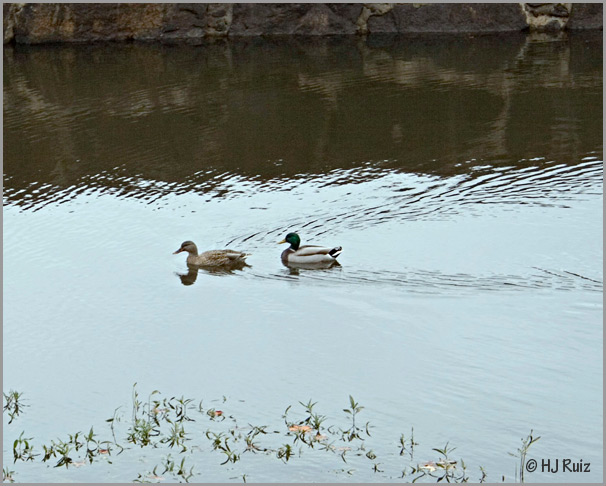
Mallards swimming, Female leads.
The Mallard is a rare example of both Allen’s Rule and Bergmann’s Rule in birds. Bergmann’s Rule, which states that polar forms tend to be larger than related ones from warmer climates, has numerous examples in birds. Allen’s Rule says that appendages like ears tend to be smaller in polar forms to minimize heat loss, and larger in tropical and desert equivalents to facilitate heat diffusion, and that the polar taxa are stockier overall. Examples of this rule in birds are rare, as they lack external ears. However, the bill of ducks is very well supplied with blood vessels and is vulnerable to cold.
Text is available under the Creative Commons Attribution-ShareAlike License; additional terms may apply. See Terms of Use for details.
Wikipedia® is a registered trademark of the Wikimedia Foundation, Inc., a non-profit organization.


 H.J. Ruiz - Avian101
You must be logged in to post a comment.