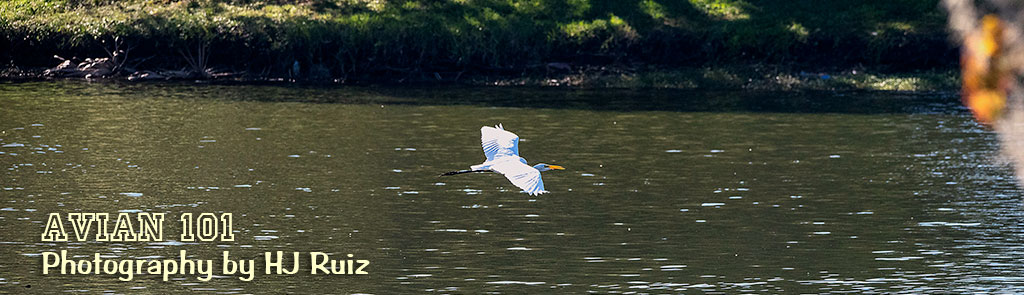
Answer to decline in population of Peruvian Pelicans
Peruvian Pelican – Sp.Name: Pelecanus Thagus
Justification Although the population of this species is now stable or perhaps even increasing, it is likely to still be recovering after dramatic declines in the El Nino year of 1998. It could suffer similar declines in the future if conditions were repeated, for these reasons it is classified as Near Threatened.
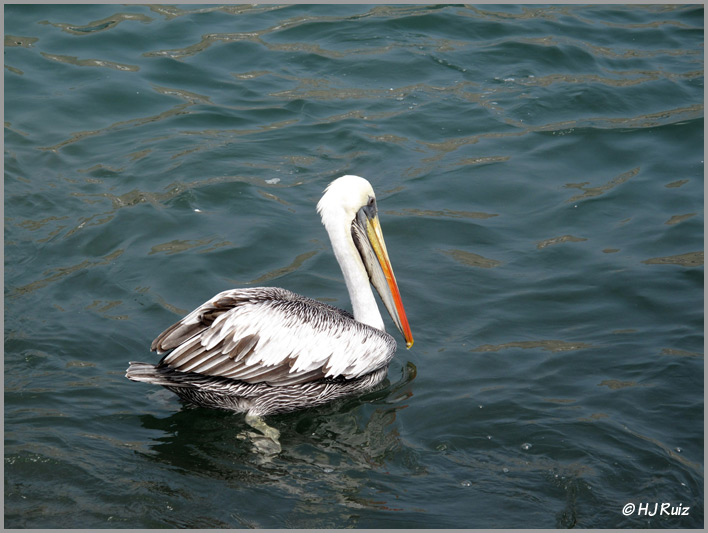
Peruvian Pelican
Taxonomic source(s) SACC (2005 + updates), Sibley and Monroe (1990, 1993), Stotz et al. (1996)
Taxonomic Note Pelecanus occidentalis and P. thagus (Sibley and Monroe 1990, 1993) previously lumped into P. occidentalis following SACC (2005), are now considered distinct species following SACC (2007).
Identification Average weight 7 kg; length 1.5 m. Dark in colour with a white stripe from the top of the bill to the crown and down the sides of the neck; pale upperwings; dark brown patch on humerals; long tufted feathers on head; facial skin dark with restricted pink around the eye; reddish bill tip; bill base yellow; blue striped gular pouch that is brighter during its breeding season. Similar species. Used to be considered a subspecies of Pelecanus occidentalis but differs in its larger size and greater length.
Population justification The most recent population estimate places it at 100,000-1,000,000 individuals (Wetlands International 2006).

Group of P. Pelicans
Trend justification It is likely to have been as badly affected by the El Niño event of 1998 as other Humboldt Current species such as Inca Tern Larosterna inca, and although the population is thought to be increasing (Wetlands International 2006), declines over 36 years (three generations) are thought to have been in the region of 10-19%.
Range and population This species is restricted to the coast of central Peru and Chile. Although the population may currently exceed 500,000 mature individuals1, this is a fraction of former numbers and numbers fluctuate greatly in association with El Niño, and with numbers of schooling anchoveta Engraulis ringens.
Ecology It breeds in large colonies on rocky coasts, feeding in shallow offshore waters along the coast on small schooling fish1.
Threats It is likely to have been as badly affected by the El Niño event of 1998 as other Humboldt Current species such as Inca Tern Larosterna inca, which declines over this period approached 30%. Pelicans are notoriously susceptible to disturbance at breeding colonies, either intentional (e.g. by fishermen), or unintentional (e.g. by tourists).
Conservation measures underway None is known.
Conservation measures proposed Survey to assess population size. Regularly monitor at certain sites throughout its range to determine population trends, particularly after El Niño years. Restrict access to important breeding colonies. Study the interactions between this species and the fisheries.
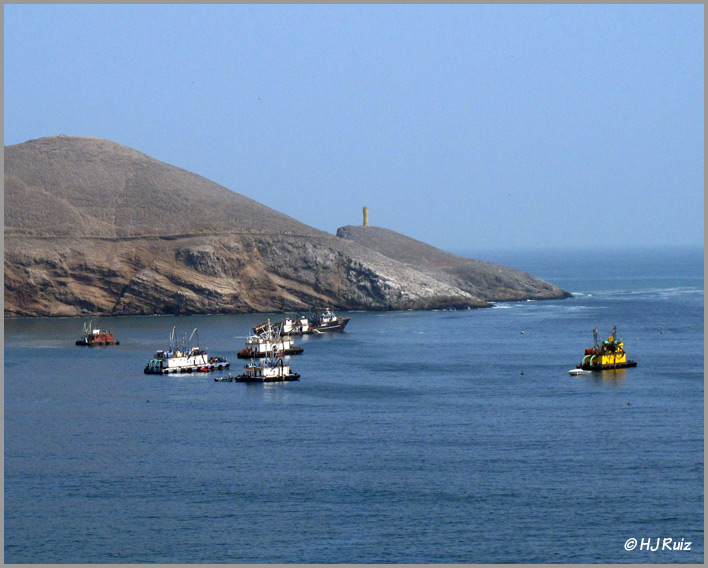
Fishing Boats at Chancay Bay
References 1. del Hoyo et al. (1992). 2. Wetlands International (2006).
Text account compliers Stuart Butchart (BirdLife International), Jonathan Ekstrom (BirdLife International), Simon Mahood (BirdLife International)
Contributors Ignacio Garcia-Godos, Alvaro P. Jaramillo, Antonio Monteiro, Alejandro Simeone and Carlos Zavalaga.
IUCN Red List evaluators Simon Mahood (BirdLife International), Stuart Butchart (BirdLife International)
Recommended citation BirdLife International (2011) Species factsheet: Pelecanus thagus. Downloaded from http://www.birdlife.org on 19/03/2011. Recommended citation for factsheets for more than one species: BirdLife International (2011) IUCN Red List for birds. Downloaded fromhttp://www.birdlife.org on 19/03/2011.
This information is based upon, and updates, the information published in BirdLife International (2000) Threatened birds of the world. Barcelona and Cambridge, UK: Lynx Edicions and BirdLife International, BirdLife International (2004) Threatened birds of the world 2004 CD-ROM and BirdLife International (2008) Threatened birds of the world 2008 CD-ROM. These sources provide the information for species accounts for the birds on the IUCN Red List.
To provide new information to update this factsheet or to correct any errors, please email BirdLife


 H.J. Ruiz - Avian101
You must be logged in to post a comment.