
Responsibility and Parasitism
In my sporadic observations to birds visiting my backyard I have encounter several instances of variety of behavior for the different species, some of these were just confirmations of known habitual actions. But once in a while I find and document certain behavior that hints a contradiction of a general concept.
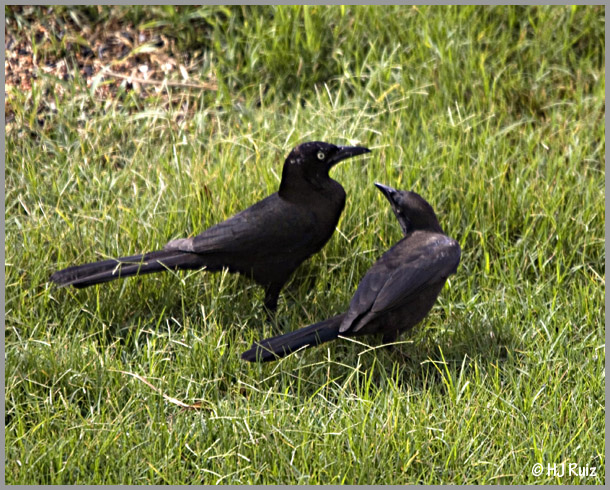
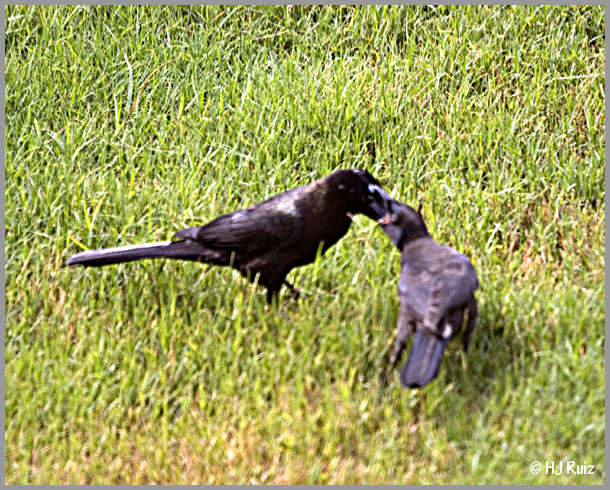
I have families of Common Grackles visiting my feeders and I have seen male and female grackles mouth feeding their little ones (Regurgitating pre-digested food).
My impression was that all classified Blackbird species were Parasitic. What I inferred from seeing grackles feeding their brood makes them birds that had nested and are being responsible for their own families. Doing some research I found that in fact this specie doesn’t frequently accepts Parasitism. Please read the abstract quoted below.
-
- Common Grackle, adult and young
-
- Common Grackle feeding the young
-
- Common Grackle, adult and young ones.
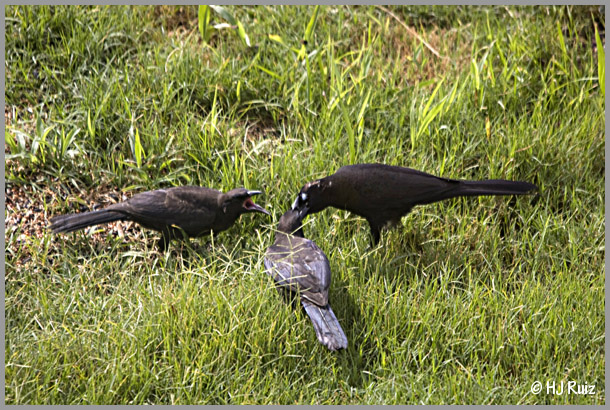
EXPLANATIONS FOR THE INFREQUENT COWBIRD PARASITISM ON COMMON GRACKLE
By Brian D. Peer and Eric K. Bollinger
Department of Zoology Eastern Illinois University, Charleston, IL
Abstract:
We determined the factors responsible for the lack of parasitism on Common Grackles (Quiscalus quiscula) by Brown-headed Cowbirds (Molothrus ater). We found no evidence of parasitism on the 401 grackle nests we monitored in east-central Illinois. By the time cowbirds began laying eggs, 88.5% of all grackle nests were beyond the point of successful parasitism. Grackles rejected cowbird eggs more frequently during the prelaying stage of the nesting cycle (38.2%) compared to later stages (12.3%). Thirty-three cowbird eggs and nestlings were cross-fostered into grackle nests. Data were collected on 15 cowbird nestlings, of which three fledged. The cross-fostered cowbird eggs that did not hatch appeared to have been incubated ineffectively. These eggs were in clutches that contained four to six eggs, whereas the cowbird eggs that hatched were in clutches of three eggs or less. Grackles also responded more aggressively toward female cowbird models than to Fox Sparrow (Passerella iliaca) models in five of seven response categories. Cowbirds avoid parasitizing grackles even though the opportunity existed. Nest abandonment and infestation of grackle nests with ectoparasitic mites may decrease the suitability of grackles as hosts; however the primary reason for the infrequent cowbird parasitism on grackles appears to be past rejection behavior. Grackles likely rejected cowbird eggs at a higher frequency in the past and as a consequence grackles were avoided by cowbirds. Rejection apparently decreased in the absence of parasitism due to the high degree of intraclutch egg variability exhibited by grackles which would increase the chances of them mistakenly rejecting their own discordant eggs.


 H.J. Ruiz - Avian101
You must be logged in to post a comment.