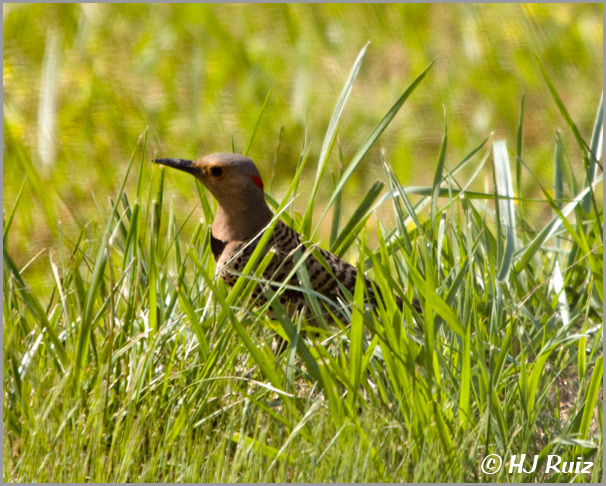
Northern Flicker
May 24, 2011 8:43 am
Anting
In the behavior called anting, birds rub insects on their feathers, usually ants, which secrete liquids containing chemicals such as formic acid, that can act as an insecticide, mitecide, fungicide, bactericide, or to make them edible by removing the distasteful acid. It possibly also supplements the bird’s own preen oil. Instead of ants, birds can also use millipedes. Over 250 species of bird have been known to ant.
Northern Flicker
History
This behaviour was first described by Erwin Stresemann in German as einemsen in Ornithologische Monatsberichte XLIII. 138 in 1935. Salim Ali interpreted an observation by his cousin Humayun Abdulali in the 1936 volume of Journal of the Bombay Natural History Society with discussion on Stresemann’s paper and the suggestion that the term could be translated into English as “anting”.
Some birds have been seen dusting themselves with soil from ant-hills and this has been considered by some as equivalent to anting.
Function
It has been suggested that anting acts as way of reducing feather parasites such as mites or in controlling fungi or bacteria, although there has been little convincing support for any of the theories. It is possible that the use of certain kinds of ants indicates the importance of the chemicals they release. Some cases of antinginvolved the use of millipedes or Puss Moth caterpillars, and these too are known to release powerful defensive chemicals.
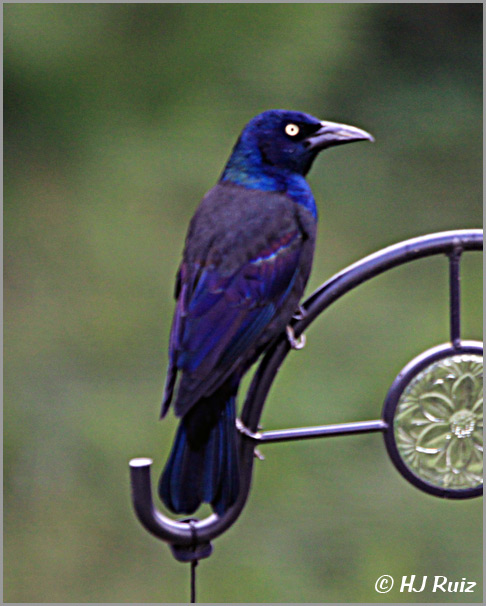
Common Grackle
Another suggested function, based on observation of Blue Jays, is that the bird makes the insects edible, by discharging the harmful acid onto their feathers. The birds were found to show anting behaviour only if the ants had a full acid sac, and with subjects whose acid sacs had been experimentally removed, the behaviour was absent.
Finally, it has also been suggested that anting is related to feather moulting. However, the correlation may also be attributed to the greater activity of ants in summer.

Blue Jay
All photographs are © H. J. Ruiz – “My Backyard Visitors”
Text is available under the Creative Commons Attribution-ShareAlike License; additional terms may apply. See Terms of Use for details.
Wikipedia® is a registered trademark of the Wikimedia Foundation, Inc., a non-profit organization.

Posted by H.J. for avian101
Categories: Bird Stuff, Interesting Information
Tags: Anting, birding, birds, important information
You must be logged in to post a comment.
Mobile Site | Full Site
Get a free blog at WordPress.com Theme: WordPress Mobile Edition by Alex King.